 Legal rights & recognition
Unlock exclusive July discounts! Enjoy no-cost EMI and limited-time offers on your first purchase.

Get access to July offers!
Offers & discounts just for you.
Ready to incorporate? Built for founders.
Become an incorporated company at myHQ's provided premium addresses
Why should you get company registration in India?
Legal rights & recognition Enhanced credibility & brand image Access to funding & growth opportunities Need a registered office address? Get a compliant Virtual Office starting at ₹799/month.

Popular company types in India
Private Limited Company (Pvt. Ltd.)
Service-based businesses Businesses looking to issue shares Businesses seeking investment through equity-based funding Separate legal identity for the business Suitable for structured, long-term operations Limited Liability Partnership (LLP)
Professional services Firms seeking any capital contribution from partners Firms sharing resources with limited liability Operates under a partnership agreement Suitable for jointly managed businesses One Person Company (OPC)
Freelancers, Small-scale businesses Businesses looking for minimal compliance Businesses looking for single-ownership Single owner with full decision-making authority Recognised as a corporate entity 
myHQ Assured
Pre-requisite of company incorporation in India
Trusted by


Everything you need to have in place before registering your company in India.

Step 1
Finalise your company name
Before starting the registration process, search the availability of your preferred company name. Make sure your finalised company name is available. Check your company name here.

Step 2
Finalise your company type & address
Confirm your official business address and gather all required documents.
Don’t have a professional business address? - Use a Virtual Office recommended by CS and CA’s all over India
Company Incorporation in India: A Complete Step-by-Step Guide
Incorporating a company in India is the formal legal process through which a business obtains a distinct identity, separate from its owners, under the provisions of the Companies Act, 2013. Once incorporated, the entity can enter contracts, own assets, incur liabilities, and operate as a legally recognised body in its own name.
This guide covers the complete incorporation process applicable across all company types registered in India. Whether you are evaluating structures or already prepared to file, this resource walks you through every stage, from pre-incorporation requirements to post-incorporation compliance, with verified legal references throughout.
Table of contents 
Table of contents
What company incorporation means under Indian law
Company incorporation in India is governed primarily by the Companies Act, 2013, and administered by the Ministry of Corporate Affairs (MCA). The Registrar of Companies (RoC), functioning under the MCA, is the competent authority responsible for processing incorporation applications and issuing the Certificate of Incorporation (CoI).
Section 3 of the Companies Act, 2013 defines the minimum membership requirements for forming a company. Under Section 3(1), a company may be incorporated by seven or more persons for a public company, two or more persons for a private company, or one person for a One Person Company (OPC). Upon successful incorporation, the MCA issues a Certificate of Incorporation bearing a unique Corporate Identity Number (CIN), which serves as the company's permanent legal identification.
Why Incorporate a Company in India?
Separate Legal Identity
An incorporated company is a juristic person under law. It can own property, hold bank accounts, initiate legal proceedings, and enter into contracts in its own name, independent of its shareholders or directors.
Limited Liability Protection
Shareholders of an incorporated company bear liability only to the extent of their unpaid share capital. Personal assets of founders and investors are protected from the company’s business debts and obligations.
Perpetual Succession
The existence of an incorporated company is not affected by changes in ownership, death of a director, or transfer of shares. The company continues to exist as a legal entity until it is formally wound up.
Access to Institutional Funding
Venture capital firms, angel investors, banks, and financial institutions typically require businesses to be incorporated before extending funding, credit facilities, or investment. A Certificate of Incorporation, along with a Corporate Identity Number, provides the legal standing required for such transactions.
Tax Advantages and Government Schemes
Incorporated companies, particularly those registered under DPIIT’s Startup India initiative, are eligible for tax benefits including exemptions under Section 80-IAC of the Income Tax Act, 1961. The base corporate tax rate for domestic companies is 22% under Section 115BAA of the Income Tax Act (introduced via the Taxation Laws (Amendment) Ordinance, 2019), with a reduced rate of 15% available for new manufacturing companies under Section 115BAB.
Credibility and Business Trust
Registration under the Companies Act, 2013 signals regulatory compliance to clients, partners, vendors, and government bodies. A Corporate Identity Number on official correspondence, letterheads, and invoices is a legal requirement post-incorporation and reinforces institutional credibility.
Types of Companies That Can Be Incorporated in India
The Companies Act, 2013 provides for the following primary company structures. Each has distinct requirements for membership, capital, and compliance. This guide addresses the common process applicable across all types. For detailed structure-specific eligibility, documentation, and procedures, refer to the dedicated guides below.
- Private Limited Company: Minimum two directors and two shareholders; most suitable for startups and growth-oriented businesses.
- One Person Company (OPC): Single shareholder who is an Indian citizen and resident; maximum paid-up capital of Rs. 50 lakh and turnover ceiling of Rs. 2 crore (as per MCA notification dated February 5, 2021, raising these limits from the original thresholds).
- Public Limited Company: Minimum seven shareholders and three directors; suitable for large-scale enterprises intending to raise capital from the public.
- Limited Liability Partnership (LLP): Governed by the Limited Liability Partnership Act, 2008; combines limited liability with partnership flexibility.
- Section 8 Company: Incorporated for charitable, educational, or social objectives; profits must be applied toward the stated objectives and cannot be distributed to members.
- Nidhi Company: Operates within the member community for mutual benefit; governed under Section 406 of the Companies Act, 2013.
Pre-Incorporation Requirements
Before filing any incorporation documents with the MCA, promoters must confirm the following eligibility conditions.
Minimum Number of Members and Directors
The minimum number of directors and shareholders varies by company type (as detailed in the structure-specific guides linked above). Across all company types registered under the Companies Act, 2013, at least one director must be a resident of India. Under Section 149(3) of the Companies Act, 2013, residency is defined as having stayed in India for a total period of not less than 182 days during the immediately preceding financial year.
No Minimum Capital Requirement
As of 2026, there is no minimum paid-up capital requirement for incorporating a Private Limited Company or a Limited Liability Partnership in India. The Companies (Amendment) Act, 2015 removed the earlier requirement of Rs. 1 lakh minimum paid-up capital for private companies and Rs. 5 lakh for public companies.
Director Identification Number Eligibility
Any individual intending to act as a director must either hold or apply for a Director Identification Number (DIN). A person convicted of an offence involving moral turpitude, or disqualified under Section 164 of the Companies Act, 2013, cannot be appointed as a director.
Registered Office Address
Every company must have a registered office address in India from the date of incorporation or within 30 days of incorporation. The address must be a physical location, not merely a virtual or correspondence address. A residential address is permissible, provided the necessary documentation is in order.
Documents Required for Company Incorporation
The following documents are required from directors and shareholders for all incorporation applications. Foreign nationals and NRI applicants must provide apostilled or notarised equivalents.
For Directors and Shareholders (Indian Nationals)
- PAN card (mandatory for all Indian directors and subscribers)
- Aadhaar card
- Passport-size photographs
- Address proof: latest electricity bill, telephone bill, or bank statement not older than two months
- Identity proof: voter ID, driving licence, or passport
For Directors and Shareholders (Foreign Nationals or NRIs)
- Passport (notarised and apostilled as per Hague Apostille Convention, 1961, for countries that are signatories; notarised through the Indian embassy for non-signatory countries)
- Address proof (apostilled or consularised utility bill or bank statement)
- If residing in India: valid visa copy
For the Registered Office
- Utility bill (electricity, water, or gas) not older than two months
- Rent or lease agreement if the premises are rented, along with a No Objection Certificate (NOC) from the landlord
- Sale deed if the premises are owned by the company or a director
Step-by-Step Process of Company Incorporation in India
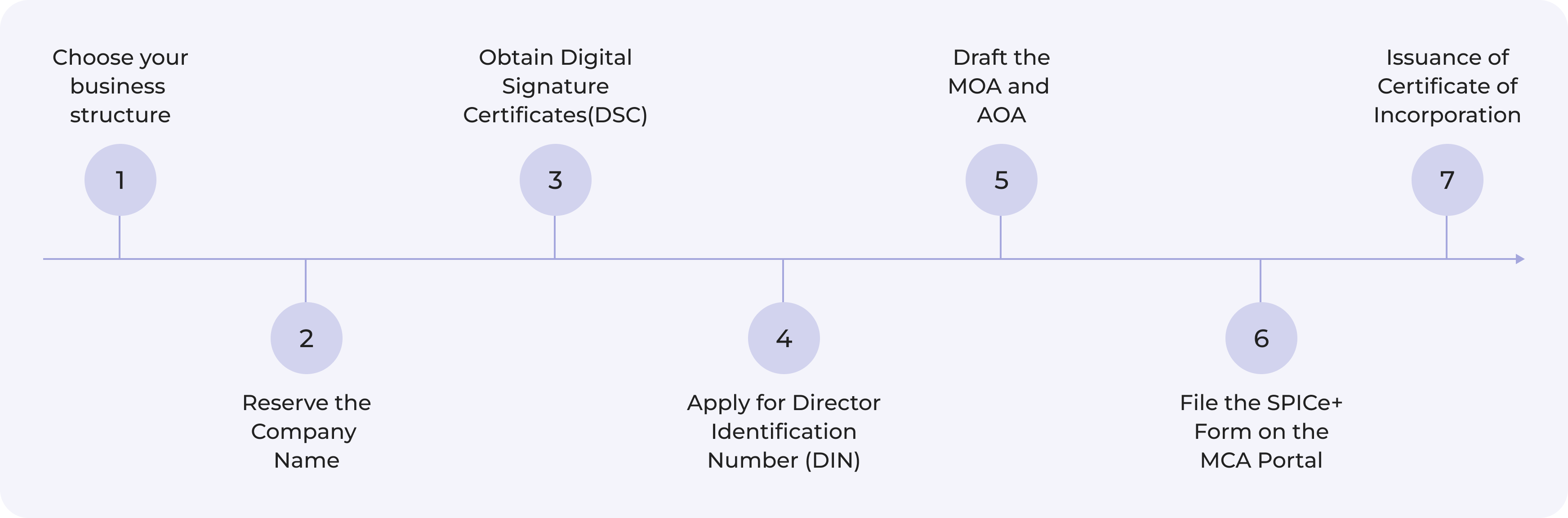
Step 1: Select the Appropriate Business Structure
The first decision is choosing the correct legal structure. This determines the applicable compliance framework, tax treatment, ownership model, and funding eligibility. Factors to evaluate include the number of promoters, nature of business activity, investment plans, liability preferences, and long-term growth strategy.
Step 2: Reserve the Company Name
The proposed company name must comply with the Companies (Incorporation) Rules, 2014 and the Companies Act, 2013. A name must be unique, relevant to the proposed business, and must not conflict with existing registered companies, LLPs, or trademarks.
How to Reserve a Name:
Name reservation is done through the MCA portal using one of two routes:
- RUN (Reserve Unique Name) Service: A standalone application for name reservation, costing Rs. 1,000 per submission. Upon approval, the name is reserved for 20 days from the date of approval.
- SPICe+ Part A: Name reservation can be applied directly as part of the main incorporation form (SPICe+), avoiding a separate RUN application.
If a name application is rejected, a fresh application with a revised name must be filed, incurring an additional Rs. 1,000 per submission.
Step 3: Obtain Digital Signature Certificates (DSC)
All proposed directors and subscribers to the Memorandum of Association must obtain a Digital Signature Certificate (DSC) before signing and filing incorporation documents electronically on the MCA portal.
A Class 3 DSC is mandatory for MCA filings. It can be obtained from any MCA-authorised Certifying Authority. As of 2026, the approximate cost of a Class 3 DSC ranges from Rs. 1,000 to Rs. 3,000 per person, depending on the certifying authority and validity period selected.
Foreign directors must submit identity and address proof, appropriately notarised or apostilled, to obtain a DSC.
Step 4: Apply for Director Identification Number (DIN)
A Director Identification Number is a unique eight-digit identifier required by every individual who intends to be appointed as a director in a company, as mandated under Section 153 of the Companies Act, 2013.
DIN can be obtained in two ways:
- Through SPICe+ (Recommended): For new incorporations, DIN is allotted through the SPICe+ form at no additional government fee for up to three directors. This is the standard and most efficient route.
- Through Form DIR-3: If more than three directors require DIN and do not already hold one, the remaining directors must apply separately via Form DIR-3 on the MCA portal, at a fee of Rs. 500 per application.
Once allotted, a DIN does not require renewal. However, directors must complete DIR-3 KYC annually to keep their DIN active.
Step 5: Draft the Memorandum of Association and Articles of Association
The Memorandum of Association (MoA) and Articles of Association (AoA) are the foundational constitutional documents of a company.
Memorandum of Association (MoA)
The MoA defines the company's relationship with the external world. It contains five mandatory clauses under the Companies Act, 2013:
- Name Clause: The legal name of the company, ending with "Private Limited", "Limited", etc. as applicable.
- Registered Office Clause: The state in which the company's registered office is situated.
- Object Clause: The main objects for which the company is formed and any incidental or ancillary objects. A company cannot legally undertake activities not mentioned in this clause without amending the MoA.
- Liability Clause: Confirms that the liability of members is limited to the amount unpaid on their shares (for companies limited by shares).
- Capital Clause: States the authorised share capital of the company and its division into shares of a fixed denomination.
The MoA is filed electronically as Form INC-33 for companies incorporated through SPICe+. If the number of subscribers exceeds seven, the MoA must be filed as a physical attachment.
Articles of Association (AoA)
The AoA governs the internal management, rules, and regulations of the company, including provisions related to share transfers, board meetings, voting rights, dividend declaration, and general meetings. The AoA is filed electronically as Form INC-34.
Both documents must be signed by all subscribers in the presence of a witness and their full addresses and occupations must be mentioned.
Step 6: File the SPICe+ Form on the MCA Portal
The SPICe+ form, short for Simplified Proforma for Incorporating Company Electronically Plus, is the integrated online application through which companies are incorporated in India. It was introduced by the MCA as a single-window clearance system, combining multiple services into one application.
SPICe+ Part A covers name reservation. SPICe+ Part B covers the main incorporation data, including company details, director and subscriber information, capital structure, and registered office particulars.
PAN and TAN are automatically issued upon approval of the SPICe+ form. MCA filing fees under the Companies (Registration Offices and Fees) Rules, 2014 are linked to the authorised share capital of the company. As of 2026:
- For authorised capital up to Rs. 15 lakh: no MCA filing fee for SPICe+ Part B
- For authorised capital between Rs. 15 lakh and Rs. 25 lakh: Rs. 2,000
- Fees increase progressively with higher authorised capital
After completing the form and attaching all required documents, the application must be digitally signed using DSCs of the directors and the certifying professional (a practising Chartered Accountant, Company Secretary, or Cost Accountant).
Step 7: ROC Review and Issuance of Certificate of Incorporation
Once the SPICe+ form and all accompanying documents are submitted, the Registrar of Companies reviews the application. The ROC may raise queries or request clarifications during this review. Once satisfied, the ROC approves the application and issues the Certificate of Incorporation (CoI).
The Certificate of Incorporation contains:
- Corporate Identity Number (CIN)
- Date of incorporation
- Company name and registered office state
- Type of company
Upon receipt of the Certificate of Incorporation, the company is legally formed and exists as a separate legal entity.
Post-Incorporation Compliance Checklist
Receipt of the Certificate of Incorporation does not authorise a company to immediately commence business operations. Several mandatory compliance steps must be completed within prescribed timeframes under the Companies Act, 2013.
- First Board Meeting (Within 30 Days)
The first Board of Directors meeting must be conducted within 30 days of the date of incorporation, as required under Section 173(1) of the Companies Act, 2013.
- Appointment of First Statutory Auditor (Within 30 Days)
Under Section 139(6) of the Companies Act, 2013, the Board of Directors must appoint the first statutory auditor of the company within 30 days of incorporation.
- Open a Company Bank Account
A current bank account in the company’s name must be opened after incorporation. This account is required to receive subscription money from shareholders, which is a prerequisite for filing Form INC-20A.
- Issue Share Certificates (Within 60 Days)
Under Section 56(4)(b) of the Companies Act, 2013, share certificates must be issued to all subscribers within 60 days of incorporation. Applicable stamp duty on share certificates must be paid within 30 days of issuance, in accordance with the Indian Stamp Act, 1899, and the relevant state stamp legislation.
- File Form INC-20A (Within 180 Days)
Form INC-20A is a declaration for commencement of business, introduced under Section 10A of the Companies Act, 2013. It is mandatory for all companies incorporated with share capital on or after November 2, 2018.
The form must be filed within 180 days of the date of incorporation. Before filing, all subscribers must have deposited the value of shares subscribed by them into the company’s bank account, and proof of the registered office address must be verified.
- Maintain Statutory Registers
From the date of incorporation, every company must maintain the following statutory registers at its registered office, as mandated under Section 88 of the Companies Act, 2013:
- Register of Members (Form MGT-1)
- Register of Directors and Key Managerial Personnel
- Register of Charges (Form CHG-7)
- Minutes Books for Board and General Meetings
These registers may be maintained in electronic form, subject to compliance with MCA norms.
- Display Company Name and CIN
Companies must paint or affix the company name and registered office address outside every place of business. The Corporate Identity Number (CIN) must appear on all letterheads, invoices, notices, bills, and official publications, as required under Section 12 of the Companies Act, 2013.
- GST Registration (Where Applicable)
GST registration is mandatory if the company’s aggregate turnover exceeds Rs. 40 lakh for goods or Rs. 20 lakh for services in a financial year (as revised by Notification No. 10/2019-CT dated March 7, 2019). For inter-state supplies or e-commerce operators, GST registration is required regardless of turnover threshold.
- Annual Compliance Requirements
Once the first financial year concludes, the company must fulfil the following annual compliance requirements:
- Annual General Meeting (AGM): First AGM must be held within nine months of the conclusion of the first financial year (Section 96, Companies Act, 2013). Subsequent AGMs must be held within six months of year-end.
- Form AOC-4: Financial statements must be filed with the ROC within 30 days of the AGM.
- Form MGT-7 / MGT-7A: Annual return must be filed within 60 days of the AGM.
- DIR-3 KYC: All directors must complete KYC verification annually to keep their DIN active.
- Income Tax Return: Filed annually with the Income Tax Department.
- TDS Compliance: Tax deducted at source must be deposited and returns filed as per the prescribed schedule under the Income Tax Act, 1961.
How Virtual Offices Support Your Company Incorporation
One of the most common practical challenges during company incorporation is securing a valid registered office address. Under Section 12 of the Companies Act, 2013, every company must have a registered office capable of receiving official communications, notices, and correspondence from the Registrar of Companies and other government bodies. For startups, freelancers, and businesses in the early stage, committing to a long-term commercial lease solely for registration purposes is neither practical nor cost-effective.
myHQ Virtual Office provides a legally compliant registered office address across 34+ cities in India, enabling founders to complete incorporation without the overhead of a physical office. With 150+ partner spaces and a network built specifically for business registration and compliance needs, myHQ has served 10,000+ clients across incorporation, GST registration, and ongoing compliance requirements.
Why Founders and Businesses choose myHQ for Company Registration
- Digital KYC and Agreement: The entire onboarding process is completed digitally. No physical visits are required to sign agreements or submit documents, which is particularly useful for founders incorporating remotely or in a city different from their base location.
- Fastest Document Turnaround Time: myHQ provides the registered office documents required for SPICe+ filing and GST registration with one of the fastest turnaround times in the industry.
- Flexible Contract Tenures: Unlike conventional commercial leases, myHQ Virtual Office plans offer flexible contract periods suited to early-stage businesses.
- Comprehensive Help and Support: A team of 50+ Virtual Office Experts is available to guide founders.
Whether you are incorporating a Private Limited Company, an LLP, an OPC, or any other structure, a myHQ Virtual Office address meets the registered office requirements under the Companies Act, 2013 and is accepted for GST registration, ROC filings, and official correspondence.
A word from our community.
myHQ has helped 10,000+ clients get their Virtual Office, boosting productivity and driving business growth.
myHQ Team provided great and fast support to us!
Great and fast service We needed an office for the registration of our company. We found Myhq through Google. The myHQ Team provided great and fast support to us. We recommend using the service of MyHQ once and you won't hesitate to use it again and again.
Harshit Arora
Director, Screen stitcheras
Get an address for your company
Stress free registrations guaranteed with myHQ
Get an address for your company
Stress free registrations guaranteed with myHQ
Frequently Asked Questions
Is there a minimum paid-up capital requirement for incorporating a company in India?
No. As of 2025, there is no minimum paid-up capital requirement for incorporating a Private Limited Company or an LLP in India. The Companies (Amendment) Act, 2015 abolished the earlier requirement of Rs. 1 lakh for private companies and Rs. 5 lakh for public companies.
Can a foreign national incorporate a company in India?
What is the Corporate Identity Number (CIN)?
How many directors can be appointed at the time of incorporation through SPICe+?
Can the registered office address be changed after incorporation?
Is GST registration mandatory immediately after incorporation?
What is the difference between authorised capital and paid-up capital?