
Step 1
Confirm your business address for GST & PPOB
Provide a valid business address for your e-commerce business—this is mandatory for GST & PPOB registration. Ensure all supporting documents are ready for verification

Unlock exclusive July discounts! Enjoy no-cost EMI and limited-time offers on your first purchase.

Get access to July offers!
Offers & discounts just for you.
Get a Virtual Office for PPOB/GST registration across 28 states and unlock the advantages of multiple fulfillment centers
Get a government-compliant virtual address for PPOB/GST registration across India


myHQ Assured


Everything you need in place before starting your GST & PPOB registration
Provide a valid business address for your e-commerce business—this is mandatory for GST & PPOB registration. Ensure all supporting documents are ready for verification
Company Registration is the first step to formalise your business as a legal entity before launching its core operations. This crucial step offers you legal rights, protection, and a solid foundation.
A Virtual Place of Business is a business address made available by a virtual office provider, backed by the documentation required under GST law, specifically a rent or service agreement in the applicant's name, a No Objection Certificate (NOC) from the property owner, and a utility bill for the address. The business uses this address to complete GST registration in a particular state without setting up or staffing a physical office there.
The term VPOB is an industry term, not a category that appears on the GST portal. When you apply for GST registration using a Virtual Office address, you are applying under the standard GST REG-01 form. What makes it a VPOB is the documentation framework behind the address, supplied and maintained by the Virtual Office provider.
The legal basis for VPOB rests on Section 2(85) of the CGST Act, 2017, which defines "place of business" broadly to include any place from which a business is carried on, where books of account are kept, or from which goods or services are supplied. This definition does not require physical occupation of a private space. As long as the documentation is genuine, consistent, and the address can receive mail and support physical inspection by a GST officer if required, a Virtual Office address qualifies as a valid place of business under the Act.
Before proceeding, three terms need to be clearly understood, as they determine when and how a VPOB is used.
The Principal Place of Business is the primary address declared under a GSTIN in a given state. This is where books of account are maintained, where the business is primarily managed for that state's GST registration, and where all GST correspondence from the tax department is sent. Every GSTIN has exactly one PPOB per state.
An Additional Place of Business is any other location within the same state, under the same GSTIN, where the business also operates. Examples include a warehouse, a showroom, a branch office, or a fulfilment centre. Multiple APOBs can exist under a single GSTIN.
A VPOB is the documentation-backed virtual address setup that can serve as either a PPOB or an APOB. It is not a third registration category on the portal. It is a way of establishing a compliant place of business address using a virtual office provider's premises and documentation, rather than a privately owned or rented physical space.
| Term | What It Means | Portal Category |
|---|---|---|
| PPOB | Primary address for a state GSTIN | Declared in GST REG-01 as Principal Place of Business |
| APOB | Additional address under the same state GSTIN | Added via Amendment of Core Fields |
| VPOB | Virtual address used as PPOB or APOB | Not a portal term; a documentation-based setup |
This is the largest use case for VPOB in India. Marketplace platforms store inventory in fulfilment centres (FCs) across multiple states. Amazon FBA warehouses, Flipkart Smart Fulfilment centres, and similar third-party logistics hubs are located in states like Maharashtra, Karnataka, Haryana, West Bengal, Telangana, and Tamil Nadu. To store goods at these centres and sell from them, the seller must have a valid GSTIN registered in that state. A VPOB provides the state-specific address required to obtain that GSTIN, after which the fulfilment centre warehouse address is added as an APOB under the same GSTIN.
Any business, regardless of size or industry, that begins selling goods or providing services to customers in a new state must be GST-registered in that state if the supply originates from there. A VPOB provides a legally compliant registered address in the target state quickly and at a fraction of the cost of setting up a physical branch.
A startup with its team distributed across India, or a service business operating from home, may need GST registrations in multiple states to invoice clients and maintain ITC chains. VPOB enables this without fixed office overhead.
Businesses involved in importing or exporting goods require valid GST registration tied to specific port cities or operational states. VPOB allows them to register at relevant locations without maintaining permanent offices there.
A consultant or advisory firm whose clients are spread across multiple states may need state-wise GST registrations to remain compliant with place-of-supply rules. VPOB is a cost-effective and legally sound way to maintain these registrations.
The comparison is direct. Setting up a physical office in a new state requires a security deposit and advance rent, fit-out costs for furniture and infrastructure, hiring or deploying local staff, utilities and maintenance overhead, and a minimum lease commitment. For a business entering a new state as a pilot or to meet a platform compliance requirement, these costs are disproportionate to the business objective.
A VPOB provides the same legal compliance outcome at a small fraction of the cost. The address is real, the documentation is genuine, the provider maintains the premises and can support physical inspection by GST officers, and the GSTIN obtained is fully valid for all GST operations including invoicing, ITC claims, and e-Way Bill generation.
| Factor | Physical Office | VPOB |
|---|---|---|
| Setup cost | High (deposit, fit-out, furniture) | Low (service fee only) |
| Lease commitment | Typically 11 months to 3 years | Flexible, often monthly or annually |
| Time to operational | Weeks to months | Days to a few weeks |
| GST compliance validity | Full | Full, subject to documentation quality |
| Physical inspection support | Native | Provided by VPOB service provider |
| Local staff required | Often yes | No |
| Suitable for multi-state expansion | Expensive to scale | Highly scalable |
Yes. A VPOB is legal under Indian GST law provided the documentation is genuine and complete.
The legal foundation is Section 2(85) of the CGST Act, 2017, which defines "place of business" in broad terms that include virtual addresses supported by documentation. Rule 8 of the CGST Rules requires address proof of the place of business to be submitted at the time of registration.
Rule 9 permits GST officers to examine the application and conduct physical verification if required. Rule 25 provides for physical verification of the business premises.
None of these provisions require the place of business to be exclusively occupied by the applicant. What they require is that the address is real, the documents are genuine and consistent, the address can receive official mail, and the location can be physically verified if an officer chooses to do so.
High Courts across India have upheld VPOB-based GST registrations in cases where documentation was complete and genuine. There is no CBIC circular, notification, or GST Council resolution that prohibits the use of Virtual Office addresses for GST registration.
The documentation package for a VPOB must meet the standard GST registration requirements as per the CBIC document checklist under Instruction No. 03/2025-GST. The following documents are required:
| Document | Requirement |
|---|---|
| Rent or service agreement | In the applicant's legal name (proprietor, LLP, company, as applicable). Must be current and not expired. State-specific stamp duty or notarisation applies where required by the respective state laws. |
| No Objection Certificate (NOC) | Signed by the property owner or the primary leaseholder of the premises, permitting the applicant to use the address for GST and business registration purposes. |
| Utility bill for the premises | Electricity bill, property tax receipt, or equivalent, in the name of the owner of the premises. Must not be older than two months from the date of filing the GST application. |
| Document | Requirement |
|---|---|
| PAN Card | PAN of the proprietor, partners, or company, as applicable |
| Aadhaar Card | For Aadhaar-based OTP authentication (strongly recommended for faster processing under Rule 9A) |
| Photograph | Recent passport-size photograph of the proprietor, partners, or authorised signatory |
| Certificate of Incorporation or Constitution Document | Incorporation certificate and MoA/AoA for companies; Partnership deed for firms; Not required for sole proprietors |
| Board resolution or authorisation letter | For companies, LLPs, and firms appointing an authorised signatory; not required for proprietors signing in their own name |
| Bank account proof | Cancelled cheque or bank statement. Must be submitted within 30 days of GSTIN issuance as per GSTN advisory dated 20 November 2025 |
| Existing GSTIN details | Required if the VPOB is being added as an APOB to an existing registration |
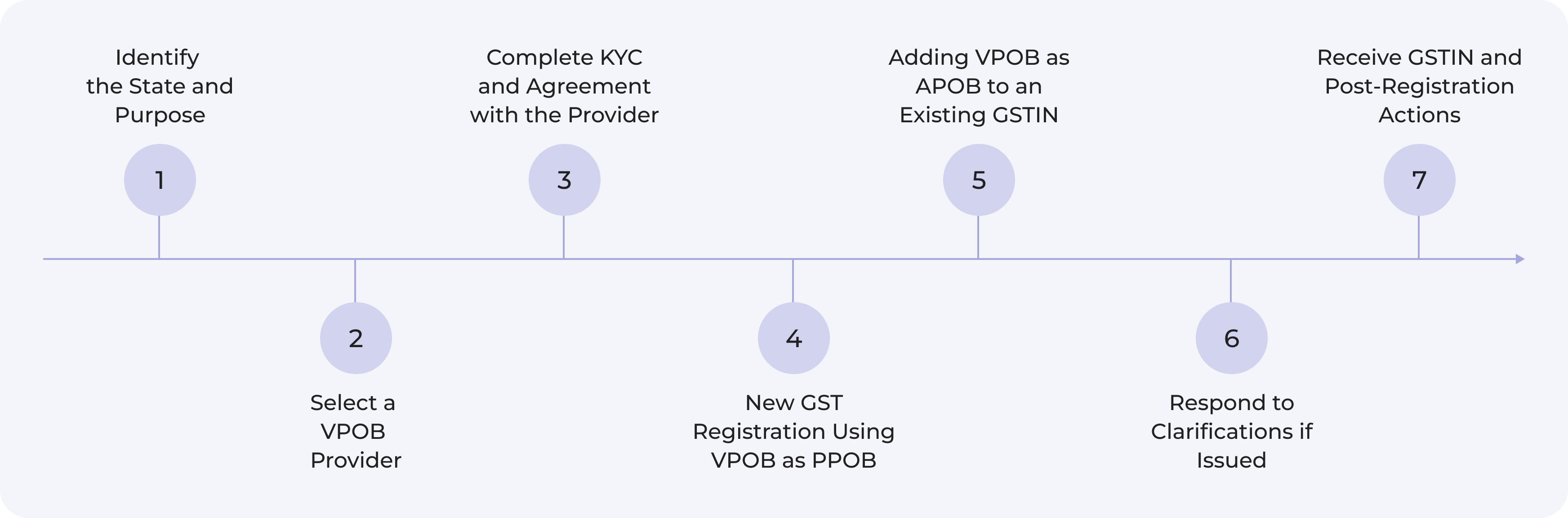
Determine which state you need a VPOB in and whether it will serve as a new GSTIN (PPOB) or as an Additional Place of Business (APOB) under an existing state GSTIN. If you already have a GSTIN in that state, you add the VPOB address as an APOB. If you have no GSTIN in that state, you apply for a new registration using the VPOB as your PPOB.
Choose a virtual office provider with addresses in the required city. Verify that the provider issues a complete documentation package: rent or service agreement in your name, a signed NOC from the property owner, a current utility bill, and signage at the physical premises. The address must be capable of receiving official GST correspondence and supporting physical inspection by a GST officer.
Submit your KYC documents to the provider. Providers offering digital KYC complete this entirely online. Once KYC is verified, the service agreement is executed. The provider prepares the full documentation package including the rent agreement, NOC, and utility bill copies.
Log in to gst.gov.in and select New Registration. In Part A of Form GST REG-01, enter your PAN, mobile number, and email address. Verify both OTPs to generate a TRN. In Part B, enter business details including the VPOB address as the Principal Place of Business, the applicable HSN or SAC codes, and bank account details. Upload the documentation package from your VPOB provider. Complete Aadhaar OTP authentication to activate the faster Rule 9A processing pathway (3 working days for Aadhaar-authenticated, low-risk applications as per CBIC Notification No. 18/2025). Submit using Aadhaar e-Sign or EVC (DSC required only for companies and LLPs). Note the ARN generated upon submission.
Log in to gst.gov.in using your existing credentials. Navigate to Services > Registration > Amendment of Registration Core Fields. In the Additional Place of Business tab, click Add New. Enter the VPOB address details including address, city, district, state, and PIN code. Upload the VPOB documentation package: rent agreement, NOC, and utility bill. Submit using DSC or EVC. Note the ARN. The amendment is processed within 15 working days.
If the GST officer raises a query through Form GST REG-03, respond within 7 working days using Form GST REG-04. Upload any additional or clearer versions of the documents requested. In states where physical verification is triggered (including Karnataka, Delhi, Maharashtra, and Tamil Nadu), the VPOB provider should facilitate access and documentation support.
Upon approval, download your GST Registration Certificate (Form GST REG-06) from the portal under Services > User Services > View/Download Certificates. For e-commerce sellers, add the marketplace fulfilment centre warehouse address as an APOB under the newly obtained GSTIN. Update bank account details within 30 days. Display the GSTIN and business name on the VPOB premises nameplate (the provider typically handles this).
For marketplace sellers, VPOB and APOB work in combination. Let's understand this standard structure with an example:
A seller based in Delhi wants to store inventory at Amazon's fulfilment centre in Maharashtra. The seller has no office or warehouse in Maharashtra. The seller obtains a VPOB address in Maharashtra and uses it to register a new GSTIN for Maharashtra with the VPOB as the PPOB. Once the GSTIN is live, the seller adds Amazon's Maharashtra fulfilment centre address as an APOB under that GSTIN. The seller can now legally inward goods to the Amazon warehouse in Maharashtra, generate GST-compliant invoices from that state, and claim ITC on stock transfers into Maharashtra.
This VPOB plus APOB combination is the standard compliance structure used by e-commerce sellers operating across multiple states in India.
| Fee Type | Amount |
|---|---|
| GST registration application fee (gst.gov.in) | Nil |
| GSTIN allotment fee | Nil |
| Amendment of registration fee (adding APOB) | Nil |
| VPOB service fee (virtual office provider, varies) | Varies by provider, city, and contract tenure |
GST registration through the official government portal is free of charge. The cost of a VPOB comes from the Virtual Office service provider, not from the government.
| Application Type | Timeline |
|---|---|
| New GST registration with Aadhaar authentication (Rule 9A) | 3 working days (effective 1 November 2025) |
| New GST registration without Aadhaar authentication | 7 working days |
| Addition of APOB via Core Fields Amendment | Up to 15 working days |
| Application with officer query (Form GST REG-03 issued) | Up to 30 days total, depending on response quality and state |
| Physical verification triggered | Up to 30 days from application date |
Selecting the right VPOB provider is not a trivial decision. The quality of the documentation package, the physical accessibility of the premises, the speed of turnaround, and the support provided during officer queries or physical inspections all determine whether your GST registration proceeds smoothly or gets delayed.
myHQ Virtual Office provides GST-compliant registered addresses across 34+ cities in India, supported by 150+ partner spaces, 50+ Virtual Office Experts, and 10,000+ clients served.
The Virtual Place of Business is not a workaround or a shortcut. It is a legally recognised, documentation-backed compliance structure that allows businesses to meet GST’s state-wise registration requirements without bearing the cost and commitment of physical offices in every state. Its legal foundation is solid, its acceptance by GST authorities is well established under CBIC Instruction No. 03/2025-GST and earlier circulars, and its practical value for e-commerce sellers, startups, and multi-state service businesses is significant.
The quality of a VPOB setup depends entirely on the quality of the documentation and the reliability of the provider. A rent agreement in your name, a signed NOC from the property owner, a current utility bill, and a physically accessible, properly signposted premises are the four non-negotiable elements. With these in place, a VPOB-based GST registration is as robust and defensible as any registration backed by a physical office lease.
myHQ has helped 10,000+ clients get their Virtual Office, boosting productivity and driving business growth.
myHQ Team provided great and fast support to us!
Great and fast service We needed an office for the registration of our company. We found Myhq through Google. The myHQ Team provided great and fast support to us. We recommend using the service of MyHQ once and you won't hesitate to use it again and again.
Harshit Arora
Director, Screen stitcheras
Stress free registrations guaranteed with myHQ
Stress free registrations guaranteed with myHQ