 Legal rights & recognition
Unlock exclusive July discounts! Enjoy no-cost EMI and limited-time offers on your first purchase.

Get access to July offers!
Offers & discounts just for you.
Ready to incorporate your One Person Company?
Become an incorporated company at myHQ’s provided premium addresses
Why should you get company registration in India?
Legal rights & recognition Enhanced credibility & brand image Access to funding & growth opportunities Need a premium address for your OPC registration? Get an MCA-compliant Virtual Office starting at ₹749/month.


myHQ Assured
Pre-requisite of One Person Company incorporation in India
Trusted by


Everything you need to have in place before registering your company in India.

Step 1
Finalise your company name
Before starting the registration process, search the availability of your preferred company name. Make sure your finalised company name is available. Check your company name here.

Step 2
Finalise your company type & address
Confirm your official business address and gather all required documents.
Don’t have a professional business address? - Use a Virtual Office – recommended by CS and CA’s all over India
One Person Company registration process in India
One Company Registration is the first step to formalise your business as a legal entity before launching its core operations. Registering an OPC gives you limited liability protection and a separate legal entity.
Table of contents 
Table of contents
Step-by-step One Person Company registration process in India
The Companies Act, 2013 introduced the concept of a One Person Company (OPC) to encourage solo entrepreneurs to formalise their businesses under a corporate structure. Before OPCs were introduced, individuals could only operate as sole proprietors if they wanted to run a business alone, as company law required a minimum of two members.
An OPC allows a single individual to enjoy the benefits of limited liability, separate legal identity, and perpetual succession, while being subject to fewer compliance requirements than a private limited company. This makes OPC an ideal structure for freelancers, consultants, professionals, and early-stage founders.
One of the most important legal requirements for OPC registration is having a valid registered office address. Entrepreneurs who do not wish to invest in a physical office at the early stage can use a myHQ Virtual Office, which fulfils all statutory address requirements under the Companies Act, 2013 at a significantly lower cost.
Advantages of one person company (OPC)
- Separate Legal Entity
An OPC has an independent legal existence separate from its members. It can own assets, incur liabilities, and enter into contracts in its own name. The liability of the member is limited to the amount of share capital subscribed, protecting personal assets from business risks.
- Easy to Obtain Funds
Banks and financial institutions generally prefer lending to companies over proprietorships. An OPC enjoys higher credibility with lenders, vendors, and clients, making it easier to secure business loans and financial facilities.
- Reduced Compliance Burden
OPCs enjoy several compliance relaxations under the Companies Act, 2013. These include exemption from preparing a cash flow statement, fewer board meeting requirements, and annual returns that can be signed by the director alone.
- Easy incorporation
An OPC can be incorporated with just one member and one nominee. There is no minimum paid-up capital requirement, making incorporation faster and more cost-effective than other company structures.
- Simple Management Structure
Since ownership and management rest with a single individual, decision-making is quick and efficient. Ordinary and special resolutions can be passed by recording them in the minute book and signing them by the sole member.
- Perpetual Succession
An OPC continues to exist even in the event of the death or incapacity of its member. The nominee appointed at the time of incorporation automatically takes over the company’s operations.
Disadvantages of one person company (OPC)
- Suitable Only for Small Businesses
An OPC can have only one member at all times. It does not allow induction of additional shareholders, limiting scalability through equity funding.
- Restrictions on Business Activities
An OPC cannot undertake Non-Banking Financial activities, invest in securities of other companies, or operate as a Section 8 charitable company.
- Ownership and Management Overlap
Since the same individual acts as both owner and director, separation between ownership and management is minimal, which may affect governance in certain situations.
One person company (OPC) registration process
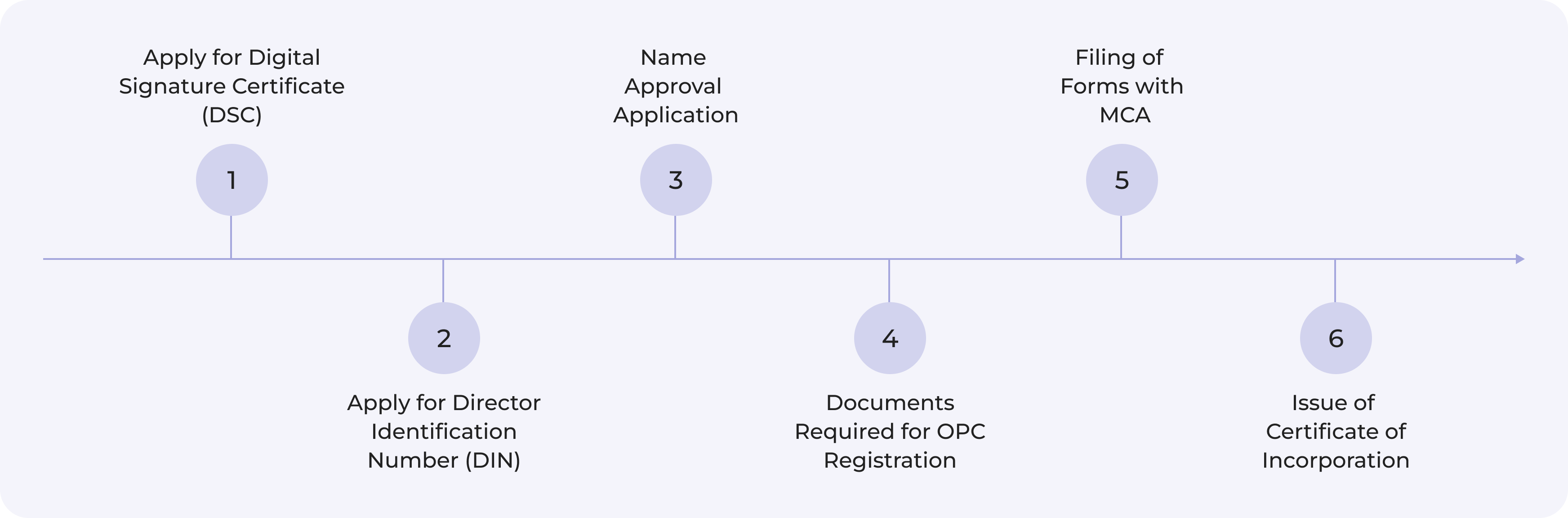
Step 1: Apply for Digital Signature Certificate (DSC)
A Digital Signature Certificate is mandatory for electronically filing incorporation documents with the Ministry of Corporate Affairs (MCA).
Documents required for DSC:
- PAN card
- Aadhaar card
- Address proof
- Photograph
- Email ID and mobile number
Step 2: Apply for Director Identification Number (DIN)
The Director Identification Number is applied for through the SPICe+ incorporation form. Separate filing of Form DIR-3 is not required for new OPC registrations.
Step 3: Name Approval Application
The proposed name of the OPC must end with “(OPC) Private Limited”. Name approval is sought through SPICe+ Part A by submitting one preferred name along with its significance.
Step 4: Documents Required for OPC Registration
The following documents are submitted to the Registrar of Companies:
- Memorandum of Association (MoA)
- Articles of Association (AoA)
- Nominee consent in Form INC-3 with PAN and Aadhaar
- Proof of registered office address
- No Objection Certificate (NOC) from the property owner
- Declarations in Form INC-9 and DIR-2
- Certification from a practising professional
Don’t have a registered address? - myHQ Virtual Office simplifies this step by providing a Companies Act–compliant registered office address along with valid address proof, utility bill, and owner NOC. This reduces the risk of address-related MCA objections and eliminates the need to maintain a physical office solely for registration purposes.
Don’t have an address yet?Get a compliant Virtual Office instantly.
Step 5: Filing of Forms with MCA
All incorporation documents are filed using SPICe+, SPICe-MoA, and SPICe-AoA. PAN and TAN are generated automatically during the incorporation process.
Step 6: Issue of Certificate of Incorporation
After verification, the Registrar of Companies issues the Certificate of Incorporation, allowing the OPC to legally commence business operations.
Checklist for registering an OPC
- One member and one nominee
- Nominee consent in Form INC-3
- Digital Signature Certificate of the proposed director
- Valid registered office address with supporting documents
Using a myHQ Virtual Office ensures ongoing compliance with registered office requirements without recurring physical office costs.
Timelines for OPC registration
- DSC and DIN: 1 working day
- Name approval: 1–2 working days
- Certificate of Incorporation: 3–5 working days
The complete OPC registration process typically takes 7–10 working days, subject to MCA approval.
Conversion of OPC into private limited company
An OPC can be voluntarily converted into a private limited company at any time by passing a special resolution, increasing the number of members and directors, and obtaining a No Objection Certificate from creditors. Mandatory conversion based on turnover or paid-up capital was removed in 2021.
Who is eligible and not eligible to form an OPC?
Eligible
- A natural person
- Indian citizen
- Resident in India (stayed in India for at least 182 days during the preceding financial year)
Not Eligible
- Minors
- Foreign citizens
- Non-residents
- Persons incapacitated to contract
Why choose myHQ Virtual Office for OPC registration?
Arranging a registered office is often the most time-consuming and expensive part of OPC registration. Leasing a physical office typically involves high security deposits, long-term lock-in periods, and recurring overheads that may not be practical for solo founders or early-stage businesses.
A myHQ Virtual Office is designed specifically to solve this problem for entrepreneurs who want to stay compliant without unnecessary costs.
myHQ Virtual Office — Trusted at Scale
myHQ supports thousands of businesses across India with compliant workspace and registered office solutions. With a strong presence across major commercial hubs, myHQ enables founders to choose a business location that aligns with credibility, customer perception, and regulatory requirements— without being physically present.
Why founders trust myHQ:
- Presence across multiple Tier 1 and Tier 2 cities in India
- Used by thousands of startups, consultants, and SMEs
- Addresses accepted by the Ministry of Corporate Affairs and GST authorities
- Standardised documentation that reduces the risk of MCA objections
Built for Compliance, Not Just Registration
A myHQ Virtual Office is not limited to incorporation alone. It provides:
- MCA-compliant registered office address
- Valid address proof and utility bill
- Owner No Objection Certificate (NOC)
- Ongoing support for statutory communications and notices
This ensures continuity of compliance even after incorporation, which is critical as address-related issues are among the most common reasons for MCA resubmissions and delays.
Cost-Efficient and Founder-Friendly
Compared to renting a physical office, a myHQ Virtual Office helps founders:
- Save significantly on setup and operational costs
- Avoid long-term lease commitments
- Eliminate delays caused by incomplete or non-compliant address documents
Location Flexibility Without Physical Presence
With myHQ’s pan-India footprint, entrepreneurs can register their OPC in a preferred business location—such as a metro city or commercial hub—while operating remotely or from home. This is especially beneficial for digital businesses, consultants, and location-independent founders.
By combining regulatory acceptance, scale, and operational simplicity, myHQ Virtual Office offers a reliable, future-ready registered office solution for OPC incorporation and ongoing compliance.
A word from our community.
myHQ has helped 10,000+ clients get their Virtual Office, boosting productivity and driving business growth.
myHQ Team provided great and fast support to us!
Great and fast service We needed an office for the registration of our company. We found Myhq through Google. The myHQ Team provided great and fast support to us. We recommend using the service of MyHQ once and you won't hesitate to use it again and again.
Harshit Arora
Director, Screen stitcheras
Get an address for your company
Stress free registrations guaranteed with myHQ
Get an address for your company
Stress free registrations guaranteed with myHQ
Frequently Asked Questions
Who is eligible to be a member of an OPC?
Only a natural person who is an Indian citizen and resident in India, meaning a stay of at least 182 days during the preceding financial year.
Can an OPC use a virtual office as its registered office?
Can a person be a member of more than one OPC?
Is there any tax advantage of forming an OPC?
Is conversion of OPC mandatory after crossing turnover limits?
What are the mandatory compliances for an OPC?