 Legal rights & recognition
Unlock exclusive July discounts! Enjoy no-cost EMI and limited-time offers on your first purchase.

Get access to July offers!
Offers & discounts just for you.
Ready to incorporate your Private Limited Company?
Become an incorporated company at myHQ's provided premium address
Why should you register your company in India?
Legal rights & recognition Enhanced credibility & brand image Access to funding & growth opportunities Need a premium address for your Pvt. Ltd Company ? Get an MCA compliant Virtual Office starting at ₹749 / month.


myHQ Assured
Pre-requisite of Private limited company incorporation in India
Trusted by


Everything you need to have in place before registering your company in India.

Step 1
Finalise your company name
Before starting the registration process, search the availability of your preferred company name. Make sure your finalised company name is available. Check your company name here.

Step 2
Finalise your company type & address
Confirm your official business address and gather all required documents
Don’t have a professional business address? - Use a Virtual Office – recommended by CS and CA’s all over India
Private limited company registration in India
Registering a Private Limited Company is one of the most common ways founders formalise their business in India. It is especially popular among startups, growing businesses, and ventures planning to raise external funding. However, registering a private limited company is not just a legal step. It is a long-term structural decision that affects compliance effort, taxation, fundraising ability, and operational flexibility.
This guide explains what a Private Limited Company is, who should and should not choose it, eligibility, documents required, step-by-step registration process, timelines, compliances, and common FAQs, with practical insights for founders registering their company in 2026.
Table of contents 
Table of contents
What is a private limited company?
A Private Limited Company is a corporate entity registered under the Companies Act, 2013, where ownership is held privately by shareholders and shares are not publicly traded.
Once incorporated, the company becomes a separate legal entity distinct from its founders. This means the company can own assets, enter into contracts, raise funds, and continue operations independently of changes in shareholders or directors. For most startups and growth-stage businesses, this structure provides the right balance between legal protection, scalability, and investor readiness.
A private limited company is commonly chosen by:
- Startups planning to raise angel or venture capital
- Businesses with multiple founders
- Companies working with enterprise or international clients
- Founders who want long-term scalability and exit options
It has:
- A separate legal identity
- Limited liability for shareholders
- Perpetual succession, independent of its owners
A Private Limited Company is ideal for businesses planning to:
- Raise external funding
- Build brand trust
- Scale operations nationally or globally
Key features of a private limited company
- Separate legal entity distinct from its owners
- Limited liability protection for shareholders
- Perpetual existence
- Better access to funding and credit
- Structured ownership and governance
Advantages of registering a private limited company
- Limited Liability and Risk Protection
One of the biggest advantages of a private limited company is limited liability. Shareholders are liable only to the extent of their shareholding. Personal assets are generally protected from business losses, debts, or legal claims, unless personal guarantees or fraud are involved. This is critical for businesses operating in regulated, contractual, or higher-risk environments.
- Fundraising and Equity Readiness
Private limited companies are the preferred structure for angel investors, venture capital firms, and institutional lenders. Equity ownership is clearly defined through shares, making it easier to issue new shares, dilute ownership, and structure investment rounds. While incorporation alone does not guarantee funding, most investors require a private limited structure before investing.
- Higher Credibility With Clients and Institutions
Compared to proprietorships or partnerships, private limited companies enjoy higher credibility with enterprise clients, vendors, banks, and government bodies. Many organisations require vendors to be incorporated companies for compliance, invoicing, and long-term contracts.
- Business Continuity and Scalability
A private limited company continues to exist even if founders exit, shareholders change, or directors resign. This continuity makes it easier to scale operations, onboard leadership, raise capital, or pursue acquisitions over time.
Disadvantages of a private limited company
- Higher Compliance Burden
Private limited companies must comply with annual filings, audits, board meetings, and statutory record-keeping under the Companies Act. These compliances are mandatory even if the company has no revenue or limited activity, which increases administrative effort compared to simpler structures.
- Ongoing Professional Costs
Incorporation and annual compliance typically require professional support from Chartered Accountants and Company Secretaries. Audit fees, ROC filing costs, and compliance support add recurring expenses, making this structure less suitable for very small or experimental businesses.
- Not Always Tax-Efficient in Early Stages
Private limited companies are taxed at corporate tax rates, which may be higher than individual income tax slabs applicable to proprietorships or freelancers in the early stages. This makes tax planning an important consideration before choosing this structure.
Who should and should not choose a private limited company?
Suitable For:
- Startups planning to raise external funding
- Businesses with two or more founders
- Companies working with large corporates or global clients
- Founders aiming for long-term scale or exit
Not Ideal For:
- Solo founders testing an idea with low revenue
- Businesses prioritising minimal compliance and tax simplicity
- Founders not planning to raise equity or scale significantly
Eligibility criteria for private limited company registration
To register a Private Limited Company in India, the following conditions must be met:
- Minimum 2 shareholders
- Minimum 2 directors
- At least one director must be a resident of India (182 days stay)
- Maximum 200 shareholders
- Directors must be individuals (not companies)
Documents required for private limited company registration
Director and Shareholder Documents
- PAN card
- Aadhaar card / Passport / Voter ID
- Address proof (bank statement, utility bill, etc.)
- Passport-size photograph
- Email ID and mobile number
Registered Office Documents
- Address proof of office premises
- Latest utility bill (electricity / water / gas)
- No Objection Certificate (NOC) from property owner
A valid registered office address is mandatory at the time of incorporation. Businesses that do not want to lease a physical office can legally use a Virtual Office as their registered office, provided valid MCA-compliant documents are submitted.
Step-by-step process for private limited company registration
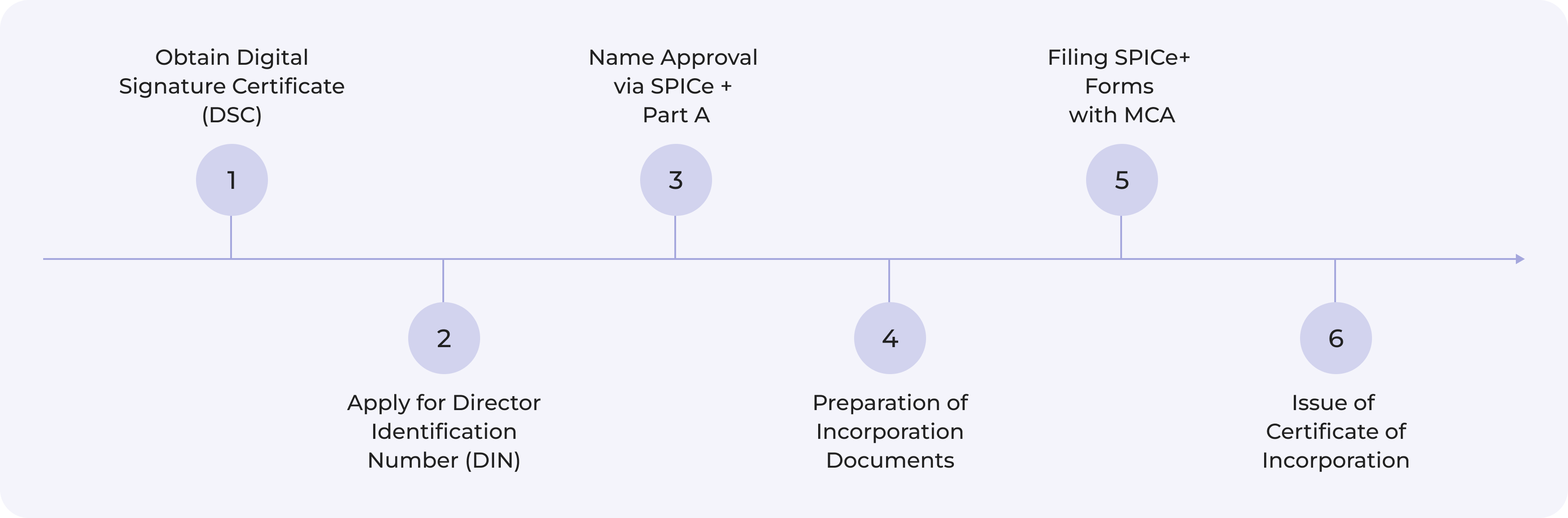
Step 1: Obtain Digital Signature Certificate (DSC)
DSC is mandatory for directors to sign incorporation forms electronically on the MCA portal.
Step 2: Apply for Director Identification Number (DIN)
DIN is applied for through the SPICe+ incorporation form. Separate DIN filing is not required for new companies.
Step 3: Name Approval via SPICe+ Part A
The proposed company name must:
- Be unique
- Not infringe trademarks
- End with “Private Limited”
One or two names can be submitted with their significance.
Step 4: Preparation of Incorporation Documents
This includes:
- Memorandum of Association (MoA)
- Articles of Association (AoA)
- Declarations and consent forms
- Registered office proof
Don’t have an address yet?Get a compliant Virtual Office instantly.
Step 5: Filing SPICe+ Forms with MCA
SPICe+, SPICe-MoA, and SPICe-AoA are filed together. PAN and TAN are automatically generated upon approval.
Step 6: Issue of Certificate of Incorporation
After verification, the Registrar of Companies issues the Certificate of Incorporation, officially creating the company.
Timeline for private limited company registration
- DSC & DIN: 1 working day
- Name approval: 1–2 working days
- Incorporation approval: 3–5 working days
Total timeline: 7–10 working days (subject to MCA approval)
Mandatory Compliances After Incorporation
A Private Limited Company must comply with the following annually:
- Appointment of statutory auditor
- Maintenance of books of accounts
- Statutory audit of financial statements
- Filing AOC-4 and MGT-7 with ROC
- Filing income tax return
Non-compliance can lead to heavy penalties and director disqualification.
Statutory Audit and ROC Filings
Every private limited company must appoint a statutory auditor within 30 days of incorporation. An annual audit is mandatory regardless of turnover. Financial statements (AOC-4) and annual returns (MGT-7) must be filed with the ROC each year.
Accounting and Bookkeeping
Proper books of accounts must be maintained at all times. Most early-stage companies outsource accounting and compliance to a Chartered Accountant rather than maintaining in-house teams during the initial years.
Board Meetings and Governance
A minimum number of board meetings must be conducted annually, and statutory registers must be maintained. These requirements promote transparency but add operational overhead.
Private Limited Company vs Other Business Structures
- Vs Proprietorship: Better credibility, liability protection, scalability.
- Vs OPC: Suitable for multiple founders and investors
- Vs LLP: Better for fundraising and equity issuance as there is more flexibility for issuing shares and raising capital
Registered Office Requirement and Using a Virtual Office
A valid registered office address is mandatory for private limited company registration and ongoing compliance. Address-related issues are among the most common reasons for MCA resubmissions and delays.
Founders who do not want to lease a physical office at the incorporation stage can legally use a Virtual Office as their registered office, provided valid MCA-compliant documents are submitted.
myHQ Virtual Office provides:
- MCA-accepted registered office address
- Valid address proof and utility bill
- Owner No Objection Certificate
- Ongoing support for statutory communications
This allows founders to stay compliant without high rental costs or long-term lease commitments, especially in the early stages.
myHQ Virtual Office provides an MCA-compliant registered office address along with required documents such as address proof, utility bill, and owner NOC—accepted by the Ministry of Corporate Affairs.
With 10,000+ companies served and 100+ locations across major Indian cities, myHQ offers a cost-effective and reliable alternative to physical offices. It also allows founders to register their company in a preferred city without being physically present.
This makes myHQ suitable for startups, consultants, and remote-first businesses looking to stay compliant while keeping setup costs low.
A word from our community.
myHQ has helped 10,000+ clients get their Virtual Office, boosting productivity and driving business growth.
myHQ Team provided great and fast support to us!
Great and fast service We needed an office for the registration of our company. We found Myhq through Google. The myHQ Team provided great and fast support to us. We recommend using the service of MyHQ once and you won't hesitate to use it again and again.
Harshit Arora
Director, Screen stitcheras
Get an address for your company
Stress free registrations guaranteed with myHQ
Get an address for your company
Stress free registrations guaranteed with myHQ
Frequently Asked Questions
Who can register a Private Limited Company in India?
Any individual who is at least 18 years old. At least one director must be a resident of India, meaning they have stayed in India for 182 days or more in the previous financial year.
How many people are required to start a Private Limited Company?
Is there a minimum capital requirement for Pvt Ltd registration?
How long does it take to register a Private Limited Company?
Can a Private Limited Company be registered at a virtual office address?
Is GST registration mandatory for a Private Limited Company?
What taxes does a Private Limited Company have to pay?
Can a Private Limited Company have a single director?
Is it mandatory to appoint an auditor after incorporation?
What are the annual compliances for a Private Limited Company?
Can a Private Limited Company be converted into another entity later?
Is company registration completely online?