 Legal rights & recognition
Unlock exclusive July discounts! Enjoy no-cost EMI and limited-time offers on your first purchase.

Get access to July offers!
Offers & discounts just for you.
Ready to incorporate your Limited Liability Partnership?
Become an incorporated company at myHQ’s provided premium addresses
Why should you register your company in India?
Legal rights & recognition Enhanced credibility & brand image Access to funding & growth opportunities Need a premium address for your Limited Liability Partnership? Get an MCA compliant Virtual Office starting at ₹749 / month.


myHQ Assured
Pre-requisite of LLP incorporation in India
Trusted by


Everything you need to have in place before registering your company in India.

Step 1
Finalise your company name
Before starting the registration process, search the availability of your preferred company name. Make sure your finalised company name is available. Check your company name here.

Step 2
Finalise your company type & address
Confirm your official business address and gather all required documents.
Don’t have a professional business address? - Use a Virtual Office – recommended by CS and CA’s all over India
Limited Liability Partnership registration in India
A Limited Liability Partnership (LLP) is one of the most preferred business structures in India for professionals, startups, and small to medium-sized businesses. It combines the operational flexibility of a traditional partnership with the limited liability protection of a company, making it both cost-effective and legally secure.
Introduced under the LLP Act, 2008, LLPs are especially suitable for businesses that do not require heavy external funding, are looking to remain bootstrapped but still want credibility, compliance, and scalability.
This guide explains what an LLP is and when does having an LLP make sense, its benefits and limitations, eligibility, documents required, the step-by-step LLP registration process, timelines, common mistakes, post-registration compliances, and FAQs, with practical insights for registering an LLP in India in 2026.
Table of contents 
Table of contents
What is a limited liability partnership (LLP)?
A Limited Liability Partnership (LLP) is a separate legal entity formed by two or more partners, where each partner’s liability is limited to their agreed contribution.
Legal Meaning of LLP Under the LLP Act, 2008
An LLP is recognized as a separate legal entity under the Limited Liability Partnership Act, 2008. Key points include:
- Has a legal identity separate from its partners
- Can own property, enter into contracts, and sue or be sued in its own name
- Limits the liability of partners to their agreed capital contribution
How LLP Is Different From a Traditional Partnership
Unlike a traditional partnership firm, an LLP provides additional legal and operational protections:
- Partners are not personally liable for the misconduct, negligence, or business losses caused by other partners
- The LLP enjoys perpetual succession, continuing to exist even if partners change or exit
- Compliance and registration are governed by the Ministry of Corporate Affairs (MCA), ensuring legal recognition and regulatory oversight
LLPs are governed by the LLP Act, 2008 and registered with the Ministry of Corporate Affairs (MCA).
Should You Register an LLP? Start Here
Before diving into the legal definitions and registration process, it’s important to assess whether an LLP aligns with your business goals and growth plans.
When an LLP Is the Right Choice
An LLP works well if you:
- Run a professional or service-based business such as consulting, legal, accounting, design, or IT services
- Are bootstrapped and not planning immediate venture capital or angel funding
- Want limited liability protection without complex corporate governance
- Have two or more partners actively involved in day-to-day operations
Prefer lower ongoing compliance compared to a Private Limited Company
When an LLP May Not Be Suitable
An LLP may not be ideal if you:
- Plan to raise external equity funding or issue ESOPs
- Expect rapid scale, acquisition, or exit strategies
- Want maximum tax optimisation at higher profit levels
- Prefer a business structure that investors are already familiar and comfortable with
In such cases, a Private Limited Company is often a better long-term choice, offering greater flexibility for fundraising, equity distribution, and scaling.
LLP vs other business structures
When choosing the right business structure, it’s helpful to compare an LLP with Private Limited Companies, Sole Proprietorships, and One Person Companies (OPCs) to understand the pros, cons, and suitability.
LLP vs Private Limited Company
- Fundraising: LLPs cannot issue shares and are limited to partner contributions, whereas Private Limited Companies can raise venture capital and issue equity.
- Compliance: LLPs have fewer filings but stricter penalties for late submissions; Private Limited Companies have more compliance requirements but are structured for investor confidence.
- Tax: LLPs are taxed at a flat 30%, while Private Limited Companies can have tax planning flexibility under different regimes.
- Scalability: LLPs have limited scalability, whereas companies scale better and are investor-friendly.
LLP vs Sole Proprietorship
- Liability: LLP partners have limited liability, whereas proprietors are personally liable for business debts.
- Credibility: LLPs are generally more credible with banks, clients, and vendors.
- Continuity: LLPs have perpetual succession, while a sole proprietorship ends with the owner.
LLP vs One Person Company (OPC)
- Ownership: LLPs require at least two partners; OPCs are owned by a single person.
- Audit: LLP audits are conditional based on turnover or contribution, whereas OPC audits are mandatory.
- Tax: Both are taxed at corporate rates, but OPCs may have more options under certain regimes like Section 115BAA.
Key features of an LLP
- Separate Legal Entity
An LLP is recognised as a distinct legal entity, separate from its partners. It can own property, enter contracts, sue or be sued, and conduct business in its own name, providing credibility and stability for professional and commercial operations.
- Limited Liability Protection
Each partner’s liability is limited to their agreed capital contribution. Personal assets remain protected, except in cases of fraud, wrongful conduct, or legal violations. This feature makes LLPs ideal for professionals and small businesses seeking risk protection.
- No Minimum Capital Requirement
There is no prescribed minimum capital required to start an LLP. Partners can contribute any amount, which allows flexible structuring of ownership and investment based on business needs.
- Flexible Internal Management
LLPs offer high management flexibility. Partners can define roles, profit-sharing, and decision-making processes through the LLP Agreement, without the rigid governance or board structures that companies require. This makes LLPs easier to manage and more adaptable for small teams.
- Lower Compliance Burden than Companies
Compared to private or public limited companies, LLPs have simpler compliance requirements, fewer annual filings, and no mandatory audits below specified thresholds. This reduces administrative overhead while maintaining legal and regulatory compliance.
- Perpetual Succession
An LLP has perpetual succession, meaning it continues to exist even if partners leave, retire, or pass away. This ensures business continuity and stability, which is particularly important for long-term professional or family-run businesses.
Benefits of registering an LLP in India
- Limited Liability Protection
Partners are liable only up to their capital contribution. Personal assets remain protected even in case of business losses.
- Separate Legal Entity
The LLP exists independently of its partners, increasing trust with clients, vendors, and banks.
- No Minimum Capital Requirement
There is no prescribed minimum capital. An LLP can be started with any amount.
- Lower Compliance Burden
Compared to Private Limited Companies, LLPs have:
- Fewer ROC filings
- No mandatory audit below specified thresholds
- Simplified annual compliance
- Tax Efficiency
LLPs are taxed at a flat rate, and dividend distribution tax does not apply.
- Suitable for Professional and Service Firms
LLPs are widely accepted for professional practices and client-facing service businesses.
Limitations of an LLP
- Not Suitable for Fundraising
Investors typically avoid LLPs due to the lack of equity shares, ESOPs, and standard exit mechanisms.
- High Late Filing Penalties
LLPs have ₹100 per day penalties with no upper cap for certain filings, making compliance discipline critical.
- Tax Inefficiency at Higher Profits
LLPs are taxed at 30 percent regardless of income level, with no slab benefits or presumptive taxation.
- Conversion Costs if You Outgrow LLP
Converting an LLP into a Private Limited Company involves legal, tax, and compliance costs that founders often underestimate.
Eligibility criteria for LLP registration
To register an LLP in India:
- Minimum 2 designated partners
- At least one designated partner must be an Indian resident
- No maximum limit on partners
- Partners must be individuals or body corporates
- A registered office address in India is mandatory
Documents required for LLP registration
Partner / Designated Partner Documents
- PAN card
- Aadhaar / Passport / Voter ID
- Address proof (bank statement / utility bill – not older than 2 months)
- Passport-size photograph
- Email ID and mobile number
Registered Office Documents
- Address proof of premises
- Latest utility bill
- No Objection Certificate (NOC) from owner
A residential, commercial, rented, or Virtual Office address can be used as the registered office if valid documents are provided.
Limited liability partnership (LLP) registration process
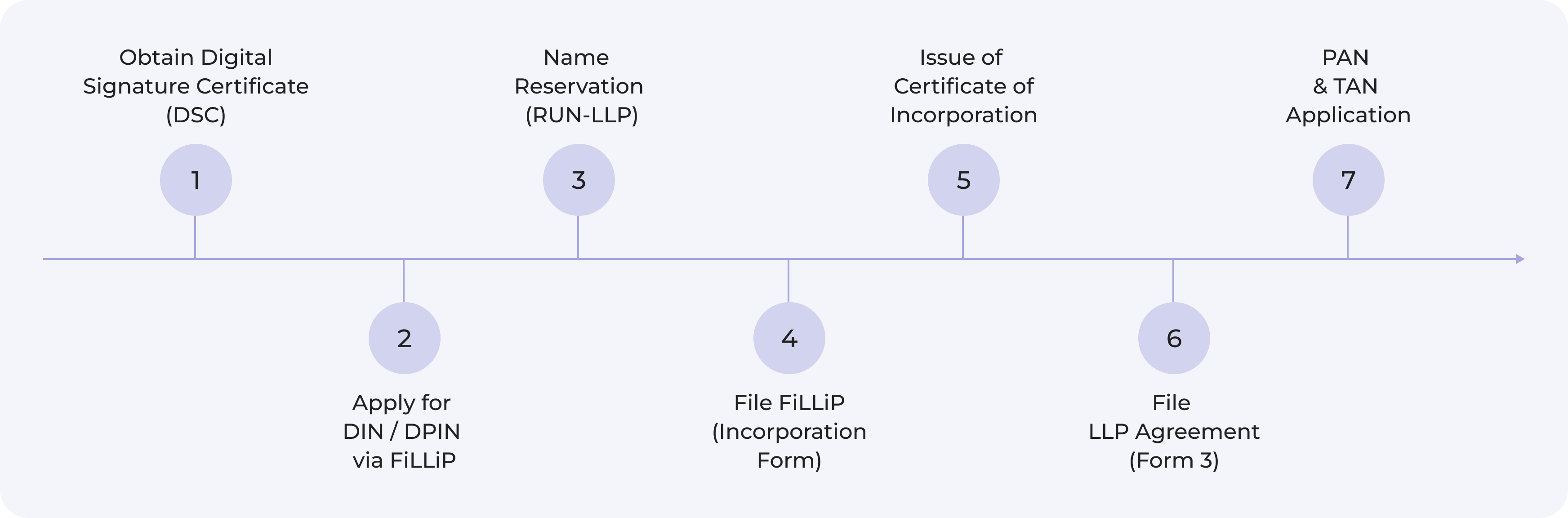
Step 1: Obtain Digital Signature Certificate (DSC)
All designated partners must obtain a Digital Signature Certificate (DSC) to sign MCA forms electronically.
Step 2: Apply for DIN / DPIN via FiLLiP
DIN is applied directly through the FiLLiP form during incorporation — no separate application is required.
Step 3: Name Reservation (RUN-LLP)
Reserve a unique LLP name through the RUN-LLP service on the MCA V3 portal .
The name must:
- Be unique
- Not violate trademarks
- End with “LLP”
Step 4: File FiLLiP (Incorporation Form)
Submit Form FiLLiP with:
- Partner details
- Capital contribution
- Registered office proof
- Declarations and consents
Step 5: Certificate of Incorporation
Upon approval, MCA issues the Certificate of Incorporation, officially forming the LLP.
Step 6: File LLP Agreement (Form 3)
The LLP Agreement must be filed within 30 days of incorporation. This defines profit sharing, rights, duties, and management structure.
Step 7: PAN & TAN Application
Apply for PAN and TAN for tax and compliance purposes.
Time required for LLP registration
- DSC & DIN: 1–2 days
- Name approval: 1 day
- Incorporation approval: 5–7 days
Total timeline: 10–15 working days, subject to MCA processing
Common Reasons for Delays in LLP Registration
Even though LLP registration is largely digital and straightforward, certain issues can cause delays in approval:
- Incorrect name selection – Choosing a name that is similar to existing entities or violates trademarks can lead to rejection.
- Incomplete registered office documents – Missing or non-compliant address proofs, utility bills, or NOC from the property owner.
- Missed LLP Agreement filing – Filing Form 3 (LLP Agreement) late or incorrectly can trigger penalties and slow down the process.
Tip: Ensuring all documents are complete, accurate, and submitted on time can significantly reduce registration delays.
Common mistakes to avoid during LLP registration
- Choosing a name similar to existing entities
- Missing Form 3 deadline (₹100 per day penalty)
- Incorrect partner contribution details
- Incomplete registered office documents
- Ignoring post-registration compliances
Mandatory compliances after LLP registration
- Filing Form 8 (Statement of Account & Solvency)
- Filing Form 11 (Annual Return)
- Income tax return filing
- Audit only if:
- Turnover exceeds ₹40 lakh, or
- Contribution exceeds ₹25 lakh
LLP annual compliance cost in India (2026)
While LLPs have a lower compliance burden than companies, founders should budget for the following annual costs to remain fully compliant in 2026:
ROC Filings
- Form 8 (Statement of Accounts & Solvency): ₹4,500–₹6,500 (if filed via professional services)
- Form 11 (Annual Return): ₹2,500–₹4,500
Professional Fees
Chartered Accountant / Company Secretary for filing ROC forms, accounting, and advisory: ₹12,000–₹30,000 annually depending on business size and complexity.
Audit Costs (Conditional)
- Applicable if turnover exceeds ₹40 lakh or capital contribution exceeds ₹25 lakh
- Approximate cost: ₹18,000–₹55,000 per year depending on the auditor and business complexity
Other Expenses
PAN/TAN updates, GST filings (if applicable), bank-related charges: ₹2,500–₹6,000
Estimated Total Annual Cost: ₹17,500–₹95,000
Note: Actual costs vary based on business size, turnover, and whether professional services are used. Even with these costs, LLPs remain far more cost-effective than Private Limited Companies for small and medium-sized businesses.
Income Tax Filing
LLPs must file income tax returns annually, regardless of profit or loss.
Penalties for Non-Compliance
Late filing attracts ₹100 per day penalties, with no maximum cap for certain forms.
Taxation of LLPs explained
Income Tax Rate
LLPs must file income tax returns annually, regardless of profit or loss.
No Presumptive Taxation
LLPs cannot opt for presumptive taxation schemes.
Profit Distribution
Profit distribution to partners is exempt in their hands, but tax is already paid at LLP level.
GST Applicability
GST applies based on turnover or business activity, not on entity type.
How a Virtual Office can help with LLP registration
A registered office address is mandatory for LLP incorporation and ongoing MCA compliance. Leasing a physical office at an early stage can be costly and unnecessary.
myHQ Virtual Office provides:
- MCA-compliant registered office address
- Utility bill, address proof, and owner NOC
- Presence in 100+ locations across India
- Trusted by 10,000+ businesses
This allows founders to register and operate their LLP legally without the burden of a physical office.
Conclusion
LLP registration in India is done online through the MCA portal and typically takes 15-20 days. With limited liability, lower compliance costs, and operational flexibility, LLPs are an excellent choice for professionals and growing businesses.
Understanding the compliance effort, tax impact, and long-term scalability before registering an LLP helps founders avoid costly restructures later.
If your priority is steady operations with manageable compliance, an LLP can be an effective and sustainable business structure in India.
A word from our community.
myHQ has helped 10,000+ clients get their Virtual Office, boosting productivity and driving business growth.
myHQ Team provided great and fast support to us!
Great and fast service We needed an office for the registration of our company. We found Myhq through Google. The myHQ Team provided great and fast support to us. We recommend using the service of MyHQ once and you won't hesitate to use it again and again.
Harshit Arora
Director, Screen stitcheras
Get an address for your company
Stress free registrations guaranteed with myHQ
Get an address for your company
Stress free registrations guaranteed with myHQ
Frequently Asked Questions
How many partners are required to start an LLP?
A minimum of two designated partners is required. There is no maximum limit.
Is physical presence required for LLP registration?
Is a registered office mandatory from day one?
Are audits compulsory for LLPs?
Can an LLP be converted into a Private Limited Company?
How is an LLP taxed?