 Legal recognition and rights
Unlock exclusive July discounts! Enjoy no-cost EMI and limited-time offers on your first purchase.

Get access to July offers!
Offers & discounts just for you.
Ready to register GST for your Private limited company?
Get your GST registered at myHQ's provided premium addresses
Why should you get GST registration in India?
Legal recognition and rights Input tax credit benefits Easier business expansion Need a government compliant office address for GST? Get a Virtual Office starting at 799/month


myHQ Assured
Pre-requisite for GST registration of Pvt. Ltd Company in india
Trusted by


Everything you need in place before starting your GST registration

Step 1
Confirm your business address for GST
Provide a valid business address for your Private Limited Company. Don’t have one? Use a government-compliant Virtual Office address to complete your GST registration seamlessly
GST Registration for Private Limited Company: Step-by-Step Process (2026)
GST registration for a Private Limited Company is the process through which the entity obtains a Goods and Services Tax Identification Number (GSTIN) under the Central Goods and Services Tax Act, 2017. A GSTIN is the company's legal tax identity under India's unified indirect tax framework and is required to collect GST from clients, claim Input Tax Credit (ITC) on purchases, file GST returns, and conduct inter-state commerce.
A Private Limited Company, registered under the Companies Act, 2013, has a distinct documentation profile compared to sole proprietorships or partnerships. DSC-based submission, board resolutions, and company-level PAN are requirements specific to this structure.
This guide covers the complete GST registration process for Private Limited Companies in 2026, updated for Union Budget 2026 amendments and the regulatory changes under GST 2.0.
Table of contents 
Table of contents
What is a Private Limited Company?
A Private Limited Company is a corporate entity registered under the Companies Act, 2013, where ownership is held privately by shareholders and shares are not publicly traded.
Once incorporated, the company becomes a separate legal entity distinct from its founders.
This means the company can own assets, enter into contracts, raise funds, and continue operations independently of changes in shareholders or directors. For most startups and growth-stage businesses, this structure provides the right balance between legal protection, scalability, and investor readiness.
A private limited company is commonly chosen by:
- Startups planning to raise angel or venture capital
- Businesses with multiple founders
- Companies working with enterprise or international clients
- Founders who want long-term scalability and exit options
It has:
- A separate legal identity
- Limited liability for shareholders
- Perpetual succession, independent of its owners
A Private Limited Company is ideal for businesses planning to:
- Raise external funding
- Build brand trust
- Scale operations nationally or globally
Is GST registration mandatory for a Private Limited Company?
Turnover-Based Threshold
Under Section 22 of the CGST Act, 2017, a Private Limited Company must register for GST once its aggregate annual turnover crosses the applicable threshold:
| Supply Type | General States | Special Category States |
|---|---|---|
| Goods | Rs. 40 lakh | Rs. 20 lakh |
| Services | Rs. 20 lakh | Rs. 10 lakh |
Aggregate turnover includes all taxable supplies, exempt supplies, exports, and inter-state supplies across all business verticals under the same PAN. It does not include inward supplies on which tax is payable under the Reverse Charge Mechanism (RCM).
Mandatory Registration Regardless of Turnover
Under Section 24 of the CGST Act, a Private Limited Company must register irrespective of turnover if it makes inter-state supply of taxable goods, supplies through e-commerce operators required to collect TCS, or falls under other mandatory registration categories under Section 24 of the CGST Act.
Section 24 of the CGST Act. E-commerce operators are required to collect Tax Collected at Source (TCS) under Section 52 of the CGST Act.
Voluntary Registration
A Private Limited Company below the threshold may opt for voluntary registration under Section 25(3) of the CGST Act. This is relevant for companies supplying to B2B clients requiring GST-compliant invoices or those making significant purchases and wishing to claim ITC from inception. Once registered voluntarily, cancellation cannot be applied for before one year from the effective date of registration, per the proviso to Section 29(1) of the CGST Act.
Benefits of GST registration for a Private Limited Company
Input Tax Credit: A registered company can set off GST paid on purchases, including raw materials, professional services, and capital goods, against its output tax liability, eliminating the cascading tax-on-tax effect.
Inter-State Business Operations: Without a GSTIN, a Private Limited Company cannot conduct inter-state supply of taxable goods or services. Registration is a prerequisite for operating beyond the home state.
Legal Compliance and Contractual Eligibility: Government tenders, corporate procurement frameworks, and institutional contracts require suppliers to hold a valid GSTIN. Registration protects the company from disqualification in such processes.
Improved Credit Profile: A consistent GST compliance track record contributes to the company's financial credibility with banks, NBFCs, and investors.
Budget 2026 Benefit: Post-Supply Discount Flexibility: Under Finance Bill, 2026, Section 15(3)(b) of the CGST Act has been amended to remove the requirement of a pre-existing agreement for post-supply discount deductions. From the notified date (proposed April 1, 2026), companies can reduce taxable value for discounts issued via credit notes under Section 34, subject to the recipient reversing the related ITC.
Documents required for GST registration of a Private Limited Company
The following documents are required as prescribed under Form GST REG-01 and CBIC Instruction No. 03/2025-GST dated April 17, 2025.
Company-Level Documents
- PAN card of the Private Limited Company (mandatory; the legal name in the application is auto-populated from the PAN database)
- Certificate of Incorporation issued by the Registrar of Companies (MCA)
- Memorandum of Association (MoA) and Articles of Association (AoA)
Director-Level Documents (For Each Director)
- PAN card
- Aadhaar card
- Passport-size photograph in JPG format
- Address proof: latest utility bill (electricity, water, or gas) not older than two months, or a bank statement
Authorised Signatory Documents
- Board Resolution authorising a specific director or officer to apply for GST registration, file returns, and sign official communications on behalf of the company
- Digital Signature Certificate (DSC) of the authorised signatory. DSC is mandatory for Private Limited Companies under Rule 26(2) of the CGST Rules, 2017. Electronic Verification Code (EVC) via Aadhaar OTP is not permitted for companies and LLPs.
Proof of Principal Place of Business
As per CBIC Instruction No. 03/2025-GST, the acceptable documents are:
| Premises Type | Required Documents |
|---|---|
| Company-owned premises | Any one of: property tax receipt, municipal khata copy, or electricity bill not older than 2 months |
| Rented with registered agreement | Rent or lease agreement plus any one ownership proof of the lessor. Lessor's PAN or Aadhaar is not required. |
| Rented without registered agreement | Rent or lease agreement, ownership proof of lessor, and identity proof of lessor |
| Consent premises (director's residence or third-party address) | Consent letter from the owner, identity proof of the consenting owner, and any one ownership document |
| Virtual office address | Rent or lease agreement from the virtual office provider and NOC. Accepted under Instruction No. 03/2025-GST as a valid PPOB provided the address is a verifiable physical location. |
Bank Account Documents
- Cancelled cheque of the company's current bank account, or a bank statement or passbook extract showing the account number, IFSC code, and branch name
- The bank account must be in the name of the Private Limited Company. A director's personal account is not accepted.
Step-by-step GST registration process for a Private Limited Company (2026)
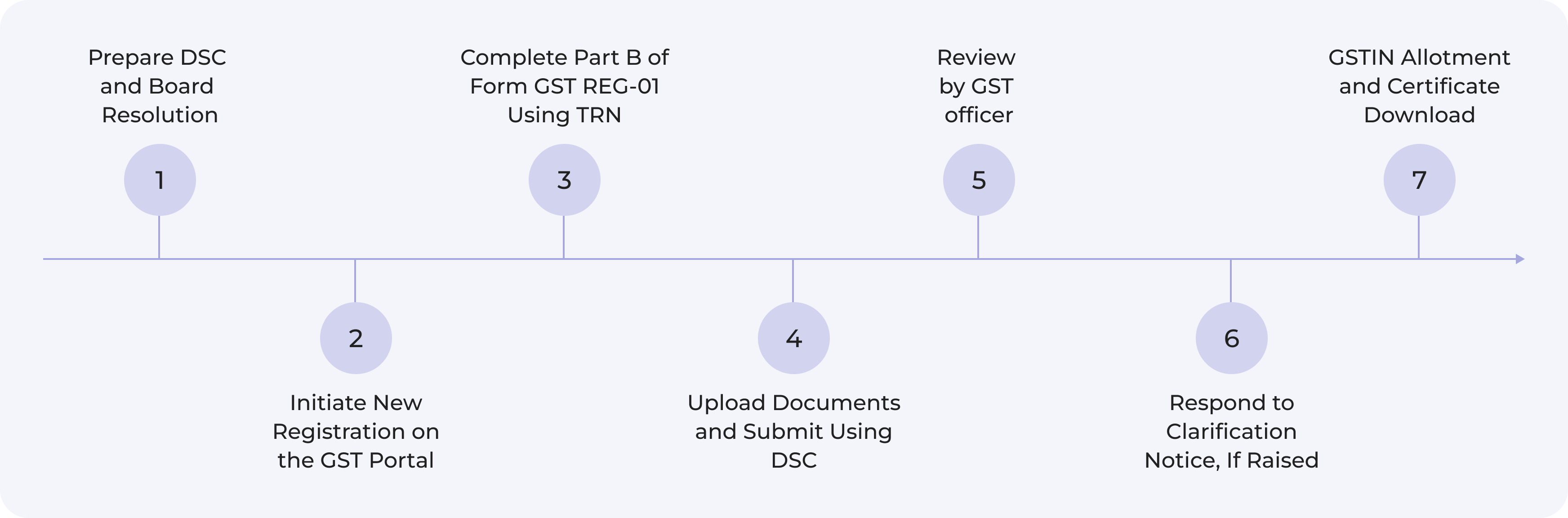
There is no government fee for GST registration. The process is conducted entirely online through gst.gov.in.
Step 1: Prepare DSC and Board Resolution Before Initiating Application
A Private Limited Company cannot submit the GST application using Aadhaar OTP. DSC-based submission is mandatory under Rule 26(2) of the CGST Rules. The authorised signatory's Class 3 DSC must be obtained and installed before initiating the process.
The board resolution authorising the signatory must be passed, signed by directors, and kept ready for upload. It must clearly state the name, designation, and authority of the signatory.
Step 2: Initiate New Registration on the GST Portal
Visit gst.gov.in and navigate to Services > Registration > New Registration. Under the I am a dropdown, select Taxpayer. Select the state and district of the principal place of business. Enter the legal name of the company as per the PAN database, the company PAN, and the mobile number and email of the authorised signatory.
An OTP is sent to both the registered mobile and email. Upon verification, a Temporary Reference Number (TRN) is generated and remains valid for 15 days.
Step 3: Complete Part B of Form GST REG-01 Using TRN
Log in to the GST portal using the TRN and complete the multi-section application.
Business Details: Select the constitution as Private Limited Company. Enter the trade name, date of incorporation, and reason for registration.
Promoters and Directors: Enter name, PAN, Aadhaar, DIN, date of birth, residential address, and designation for each director. Upload photographs in JPG format. Directors' Aadhaar must be linked to their mobile number for OTP verification during the application.
Authorised Signatory: Enter details of the director or officer authorised through the board resolution. This person's DSC will be used to submit the application.
Principal Place of Business: Enter the complete registered office address, PIN code, district, commissionerate, division, and range code. Use the jurisdiction hyperlink within the portal to identify the correct GST range. Select the nature of possession and upload corresponding address proof.
Goods and Services: Enter HSN codes for goods and SAC codes for services. A maximum of five HSN and five SAC codes are permitted at registration. Correct classification determines the applicable GST rate and the return type to be filed.
Bank Account Details: Enter the account number, IFSC code, and branch name of the company's current account. The account must be in the name of the Private Limited Company. Submission at registration is recommended to avoid post-GSTIN delays.
Step 4: Upload Documents and Submit Using DSC
Upload all documents in PDF or JPG format, with each file not exceeding 1 MB. Verify before uploading that the Certificate of Incorporation name matches the PAN and legal name in the form, the board resolution names the same person entered as the authorised signatory, and the address proof corresponds to the PPOB entered.
Submit the application using the authorised signatory's Class 3 DSC, pre-registered on the GST portal for the relevant PAN.
Upon submission, an ARN is generated and sent to the registered mobile and email. Track the application at Services > Registration > Track Application Status on the GST portal.
Step 5: GST Officer Review
The jurisdictional GST officer reviews the application. Processing timelines under the current regulatory framework are:
| Application Type | Timeline |
|---|---|
| Aadhaar-authenticated, standard application | 7 working days from ARN date |
| Non-Aadhaar or high-risk (physical verification required) | 30 working days from ARN date |
| Eligible for Rule 9A automatic electronic registration (w.e.f. November 1, 2025) | 3 working days |
Note: For Private Limited Companies, the Aadhaar authentication is performed at the director level, not at the company level. If all directors' Aadhaar authentication is completed, the application is generally processed within the 7-working-day window.
Step 6: Respond to Clarification Notice, If Raised
If the officer requires clarification, a notice is issued in Form GST REG-03. The company has 7 working days to respond in Form GST REG-04. Under CBIC Instruction No. 03/2025-GST, officers must obtain approval from the Deputy Commissioner or Assistant Commissioner before demanding documents not listed in Form GST REG-01. Common triggers in company applications include a mismatch between the Certificate of Incorporation address and the PPOB entered, or a discrepancy in director names across PAN and Aadhaar records. Non-response within 7 working days results in rejection via Form GST REG-05, requiring a fresh application.
Step 7: GSTIN Allotment and Certificate Download
Upon approval, a 15-digit GSTIN is allotted and a GST Registration Certificate is issued in Form GST REG-06, downloadable from Services > User Services > View/Download Certificate on the GST portal.
The GSTIN structure is: state code (2 digits) + company PAN (10 digits) + entity count for that PAN in the state (1 digit) + default character Z + check digit. A company operating in multiple states holds a distinct GSTIN per state, each prefixed with the relevant state code.
The GST Registration Certificate must be displayed at the registered office and all additional places of business.
How Virtual Offices support GST registration for Private Limited Companies
A verifiable principal place of business address is a mandatory requirement under the CGST Act, 2017. For newly incorporated Private Limited Companies, companies in the pre-revenue stage, or those expanding operations to new cities, securing a dedicated commercial office solely for GST registration is an avoidable overhead.
myHQ Virtual Office provides a GST-compliant registered address across 34+ cities in India, backed by 150+ partner spaces, 50+ Virtual Office Experts, and 10,000+ clients served.
- Digital KYC and Agreement: Complete onboarding online. No physical visit is required, making it efficient for founding teams incorporating and registering remotely.
- Fastest Document Turnaround Time: Receive the rent agreement and NOC required for GST REG-01 quickly, so the application timeline is not delayed by address documentation.
- Flexible Contract Tenures: No long-term lease required. Plans suit early-stage companies and those requiring separate GSTIN registrations across multiple states.
- Comprehensive Help and Support: Dedicated Virtual Office Experts guide companies through PPOB documentation, officer queries, and any REG-03 clarification notices relating to the registered address.
For a detailed walkthrough on using a Virtual Office address for GST registration, refer to GST Registration with a Virtual Office Address.
Union budget 2026 and GST 2.0: what Private Limited Companies must know
Union Budget 2026, presented on February 1, 2026, introduced targeted amendments under Finance Bill, 2026 (Clauses 137 to 141). There are no GST rate changes. The focus is on procedural clarity, improved refunds, and litigation reduction.
Post-Supply Discount Deduction (Section 15 and 34 Amendment): The pre-existing agreement requirement for post-supply discount deductions has been removed. Companies can now issue credit notes for discounts under Section 34 without a prior agreement, as long as the recipient reverses the related ITC. Applicable from the notified date after April 1, 2026.
Provisional Refund for Inverted Duty Structure (Section 54 Amendment): The 90% provisional refund facility, previously limited to zero-rated supplies, has been extended to inverted duty structure claims. This benefits companies in sectors where input GST rates exceed output GST rates, improving cash flow and reducing refund delays.
Place of Supply Clarity for Intermediary Services: Amendments clarifying the place of supply for intermediary services reduce litigation for Private Limited Companies providing back-office, IT, or support services to overseas clients.
GST 2.0 Framework: Building on the 55th and 56th GST Council recommendations, ongoing GST reform initiatives recommended by the GST Council focus on compliance simplification, return filing rationalisation, and faster registration processing, and expanded use of Rule 9A automatic electronic registration. Companies qualifying under Rule 14A (monthly output tax liability to registered persons not exceeding Rs. 2.5 lakh) benefit from a streamlined 3-working-day registration pathway effective November 1, 2025.
Post-registration compliance for Private Limited Companies
GST Return Filing: Companies with annual aggregate turnover above Rs. 5 crore must file GSTR-1 monthly by the 11th and GSTR-3B by the 20th of the following month. Companies below Rs. 5 crore may file quarterly under the QRMP scheme. GSTR-9 (annual return) is due by December 31 of the subsequent financial year. GSTR-9C (reconciliation statement) is mandatory for companies with turnover exceeding Rs. 5 crore.
E-Invoicing: Mandatory for companies with Annual Aggregate Turnover exceeding Rs. 5 crore. All B2B invoices must be uploaded to the Invoice Registration Portal (IRP) to obtain an IRN and QR code. Invoices without an IRN are invalid under the GST framework.
ITC Claims: ITC under Section 16 of the CGST Act is claimable only when the credit appears in the company's auto-populated GSTR-2B and the supplier has been paid within 180 days of the invoice date.
Statutory Record-Keeping: Under Section 35 of the CGST Act, all GST records must be maintained for a minimum of 8 years from the due date of filing the annual return for the relevant financial year.
Common mistakes to avoid
DSC Not Registered on GST Portal Before Submission: The authorised signatory's DSC must be pre-registered on the portal before filing. Attempting to submit without it causes application failure.
Board Resolution and Signatory Mismatch: The individual named in the board resolution and the signatory entered in the form must be identical. This is one of the most common REG-03 triggers in company applications.
Company PAN Used in Director Fields: Director detail sections require each individual director's PAN, not the company PAN. This causes a mismatch with the MCA database and leads to rejection.
PPOB Differs from MCA Registered Office: If the GST application lists a different address from the MCA-registered office without proper documentation explaining the change, the officer may raise a clarification notice. Ensure consistency or provide supporting documents for any alternate address.
A word from our community.
myHQ has helped 10,000+ clients get their Virtual Office, boosting productivity and driving business growth.
myHQ Team provided great and fast support to us!
Great and fast service We needed an office for the registration of our company. We found Myhq through Google. The myHQ Team provided great and fast support to us. We recommend using the service of MyHQ once and you won't hesitate to use it again and again.
Harshit Arora
Director, Screen stitcheras
Get an address for your company
Stress free registrations guaranteed with myHQ
Get an address for your company
Stress free registrations guaranteed with myHQ
Frequently Asked Questions
Is GST registration mandatory for a newly incorporated Private Limited Company with no revenue?
Not immediately. Registration becomes mandatory only when aggregate annual turnover crosses the applicable threshold, or upon commencement of inter-state supply or e-commerce operations. Voluntary registration is advisable for companies expecting B2B transactions or investor scrutiny from inception.
Can a director's residential address be used as the principal place of business for GST registration?
How many GSTINs does a Private Limited Company need if it operates in multiple states?
What is the penalty for not registering despite mandatory eligibility?
Does the Budget 2026 post-supply discount amendment affect how companies issue credit notes?